West Coast Intermodal Drayage Directory 2026
Navigating the Ports, Rails, and Regulations of the Pacific Supply Chain (2026 Edition)
Insulate your operation from chaos with precision UIIA monitoring, proactive chassis coordination, and secured port appointments. By enforcing gate timestamps and managing rail flow, regulatory hurdles transform into operational speed.
Intermodal Drayage Dispatch Region Expertise
Our expertise is built on exhaustive research into the nation's primary logistics corridors, providing specialized dispatch solutions tailored to the unique infrastructure of each major shipping hub.
The East Coast (Atlantic Gateway)
The Gulf Coast (The Energy Belt)
West Coast Cities Expertise
Intermodal Drayage Dispatch strategy centers on the nation’s primary industrial corridors, offering specialized dispatch tailored to each city's unique infrastructure. In 2026, we bridge the gap between ocean terminals and inland warehouses by navigating the specific "Green Zone" mandates and gate-cut timings that define these critical urban hubs.

West Coast Intermodal Drayage Region Directory
This directory organizes the critical infrastructure of the West Coast into a unified operational view.
We have indexed every major Class I Rail Ramp and Ocean Port across California, Washington, Oregon, Nevada, and Arizona, creating the definitive reference for intermodal drayage.
Select any State, Ocean Port, or Rail Ramp below to access deep operational intelligence.
Drill down into our specific facility guides to uncover gate hours and appointment rules, and use this table to identify the specific terminals, codes, and facility types essential for your dispatch planning.
The West Coast Corridor Network
West Coast freight flows in two directions here: Internal (North-South) and National (East-West). Intermodal Dispatch Drayage commands both.
Use this guide to identify the strategic lane that fits your operation, from high-volume short hauls in the Inland Empire to complex winter runs over the Donner Pass.
West Coast Regulatory Compliance & Risk
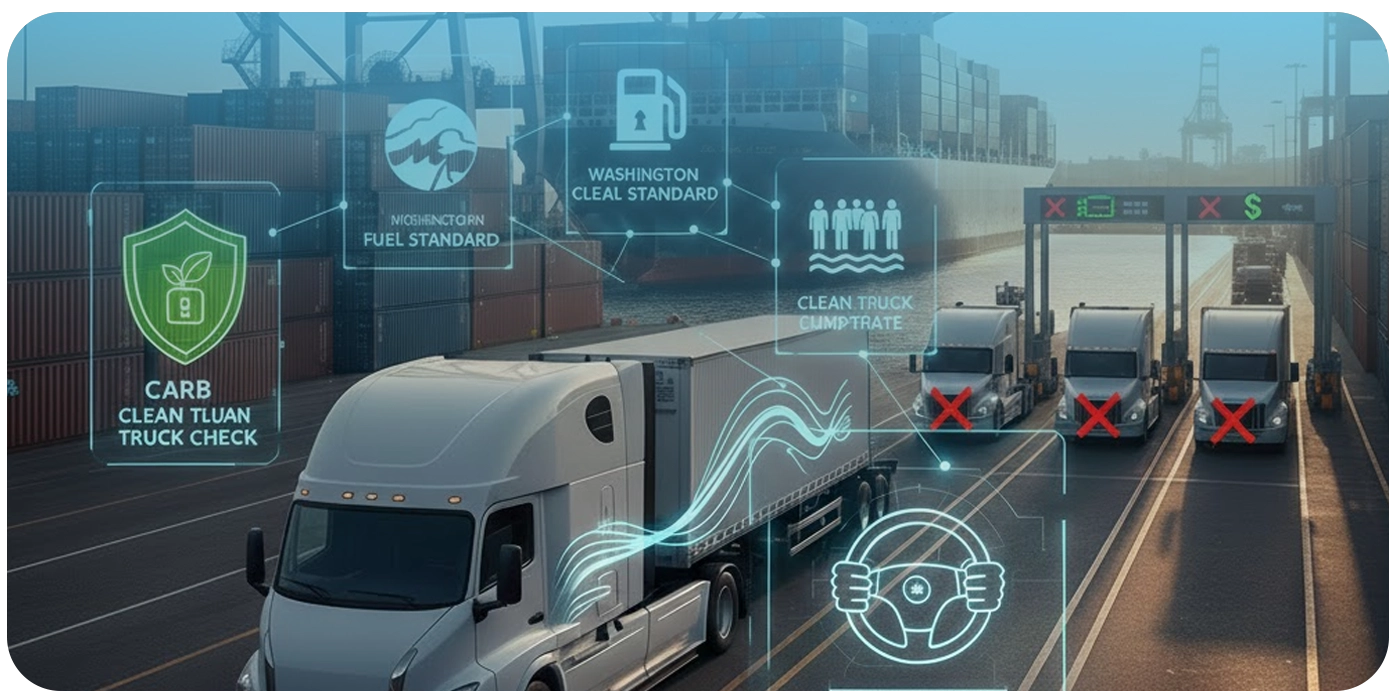
Moving freight in the West Coast region requires more than just a CDL. It requires navigating a complex web of environmental mandates, labor laws, and terminal restrictions. A single compliance error prevents your cargo from ever leaving the port.
CARB "Clean Truck Check" (CTC) Mandates ↗
California has effectively banned older diesel engines. Every truck entering a port or rail yard must be registered in the CARB Clean Truck Check database and pass semi-annual emissions testing.
The Risk: Non-compliant units are flagged instantly at the gate via ANPR cameras. The result is an immediate "Gate Lockout," citations starting at thousands of dollars, and cargo that remains stranded on the dock.
Washington Clean Fuel Standard (CFS) ↗
Washington State has activated its own low-carbon fuel mandates, mirroring California’s aggressive stance.
The Risk: As of 2026, fuel surcharges and compliance checks for diesel units operating out of Seattle-Tacoma (NWSA) have intensified. Fleets without a "Clean Fleet" strategy will face escalating operating costs that eat directly into your margin.
California Assembly Bill 5 (AB5) – Independent Contractors ↗
The "Gig Worker" law has fundamentally changed how owner-operators function in California, creating severe legal risks for misclassification.
The Risk: Utilizing independent contractors who do not meet strict "Business-to-Business" criteria can trigger state audits and lawsuits. If your carrier is flagged, the cargo owner can be held liable for the carrier’s employment taxes and penalties.
Clean Truck Fund (CTF) Rate – Port of LA/LB ↗
The Ports of Los Angeles and Long Beach charge a CTF Rate (currently $10/TEU for non-exempt trucks) to fund zero-emission infrastructure.
The Risk: This fee must be paid before pickup. If the fee is not cleared in the PortCheck system prior to the driver’s arrival, the truck will be denied entry, resulting in a "Dry Run" charge and missed appointment fees.
Advanced Clean Fleets (ACF) – The "Diesel Ban" ↗
California's most aggressive mandate. As of January 1, 2024, any new truck added to the drayage registry must be a Zero-Emission Vehicle (ZEV).
The Risk: This has effectively "frozen" the diesel capacity in the state. Fleets can no longer easily expand to meet surges. We secure capacity by utilizing carriers with "Grandfathered" diesel units and secured ZEV assets, ensuring your freight moves even during peak season crunches.
TWIC® Security Clearance (Federal) ↗
The Transportation Worker Identification Credential (TWIC) is a federal security clearance required for unescorted access to maritime facilities.
The Risk: A driver without a valid TWIC card will be turned away at the gate immediately. We verify TWIC status during carrier onboarding to prevent security-related gate rejections.
UIIA (Uniform Intermodal Interchange Agreement) ↗
The standard industry contract between truckers and equipment providers (Ocean Carriers/Railroads). It is the "Master Key" to handling intermodal equipment.
The Risk: If a carrier’s insurance lapses or they are "shut out" by a specific steamship line for unpaid per diem, they cannot physically pick up the box. We verify active UIIA status for every dispatch to prevent equipment interchange denials.
California Bridge Law (Kingpin-to-Rear-Axle) ↗
California strictly enforces a 40-foot maximum distance from the kingpin to the center of the rear axle. This is shorter than federal standards and unique to the state.
The Risk: This is the #1 ticket trap for 53' domestic containers and 40' ocean cans on sliding chassis. A non-compliant truck will be ticketed and often placed Out of Service (OOS) by the California Highway Patrol (CHP).
PierPass Traffic Mitigation Fee (TMF) – Port of LA/LB ↗
A congestion pricing fee charged on daytime container moves (Monday-Friday, 7:00 AM - 6:00 PM) at Los Angeles and Long Beach terminals.
The Risk: Unlike the CTF, this fee is avoidable by booking "Off-Peak" (night/weekend) gates. However, dispatchers who fail to claim the TMF on daytime loads will cause the container to be placed on "Billing Hold," preventing the driver from exiting the gate.
Oregon Weight-Mile Tax (The I-5 Trap) ↗
Oregon is the only state that does not participate in the standard IFTA fuel tax agreement. Trucks over 26,000 lbs must have a specific Oregon Weight-Receipt and Bond.
The Risk: This is the #1 trap for carriers running the I-5 Corridor (California to Washington). A driver with valid IFTA credentials but no Oregon Bond will be stopped at the port of entry, fined heavily, and forced to buy a temporary pass, killing your transit time.
Control the West Coast with Intermodal Drayage Dispatch
The West Coast is the most volatile logistics environment in America. Between the I-5 mountain passes, the CARB compliance audits, and the frantic port appointment windows, there is no margin for error.
You can gamble on a generalist dispatcher and risk a gate denial, or you can partner with a regional specialist who treats compliance as a competitive advantage.
We don’t just book loads. We engineer the lane.
From the first eModal appointment at Long Beach to the final mile in Chicago, we ensure your freight moves with absolute legal and operational authority.
-Thumbnail.webp)